Marine
Marine engineering services

Marine
Fuel cell technology is a green energy alternative available today, offering zero-emission propulsion for vessels of various sizes and applications. However, navigating through the complexities of adopting fuel cell solutions requires a clear understanding of the landscape, from identifying suitable vessels all the way to ensuring regulatory compliance. We help you adopt a customised fuel cell solution, guiding you through each step, enabling cleaner and greener maritime operations.

We are dedicated to making the transition to hydrogen-electric marine vessels as seamless and efficient as possible.

With decades of experience in the fuel cell industry we can identify and mitigate potential challenges, ensuring a reliable and efficient implementation. Trust us to navigate the complexities of hydrogen electrification, minimising technical risks and maximising operational success.

Our consultancy services are designed to provide you with an optimised fuel cell solution tailored to your specific needs, significantly reducing your initial R&D investment. By leveraging our expertise, you can avoid the high costs and uncertainties associated with extensive research and development.

We accelerate your transition to zero-emission operations, shortening your time to market. Our streamlined processes and proven methodologies allow us to guide and support your evaluation efficiently. This ensures that your vessel can start benefiting from cleaner, more sustainable power solutions without unnecessary delays.
We take a stepwise approach when working with your project facilitating continuous feedback, analysis and evaluation at every step. With our consultation service as the starting point, we guide you in making a solution decision based on feasibility studies and extended testing. Your solution may be one of our industrialised products, a modified product, or a turnkey solution. We support you with integration, installation, testing and operations online and onsite, as you need it.
Download our e-book to dive deeper into each step on how we can help you integrate fuel cell technology in your vessel.


The journey begins with a thorough initial consultation and assessment. We collaborate closely with you to understand your vessel’s specific requirements, operational goals, and existing infrastructure. Our team conducts a detailed evaluation to identify the most suitable hydrogen fuel cell solutions tailored to your needs. This ensures that our recommendations align with your objectives for efficiency, performance, and environmental compliance.
Following the assessment, we progress to the phase of selecting the customer-specific solution. Our engineers chooses a perfectly suited hydrogen fuel cell system, ensuring seamless integration with your vessel’s architecture. We prioritise optimising power density, efficiency, and safety, ensuring that our designs adhere to the highest standards. This phase encompasses detailed schematics, performance simulations, and a comprehensive implementation plan, offering a clear roadmap for integration.
In the installation and integration phase, our skilled technicians install the hydrogen fuel cell systems on your vessel, ensuring precise integration with existing marine systems. We handle all aspects of the installation, from mechanical and electrical connections to software integration. Our meticulous approach guarantees that the new technology is seamlessly incorporated, minimising downtime and ensuring that all systems function harmoniously.
Commissioning is a critical phase where we ensure all systems and components of your vessel are designed, installed, tested, operated, and maintained to the highest operational standards. Our process verifies that every aspect of the fuel cell system works as intended, achieving optimal performance and safety. We conduct extensive testing, fine-tuning, and validation, ensuring your vessel is ready for real-world operations. Our commissioning services deliver confidence in the reliability and efficiency of your new technology.
We collaborate with shipyards, integrators, and class societies to ensure adherence to safety and regulatory standards. Our continuous monitoring of regulatory developments and proactive engagement with relevant authorities guarantee compliance with evolving emission regulations. Transparent reporting and documentation processes streamline regulatory approval processes, building trust with regulatory bodies and stakeholders.
The final step involves comprehensive Site Acceptance Testing (SAT) and operational training. We conduct on-site testing of integrated systems to verify their functionality in real-world maritime conditions, ensuring reliability and safety. Additionally, we provide extensive training for your crew, covering operation, maintenance, and safety protocols. This ensures that your team is fully equipped to manage the new technology, maximising performance and longevity. Our commitment to excellence ensures your vessel is ready for efficient, safe, and environmentally friendly operation.


A shipowner had the objective of applying for a tender that concerned fuel cell powered passenger ferries. To understand how they could best formulate their offer to the tender and gain a deeper understanding into fuel cell-based marine operations, we were tasked with conducting total cost of ownership (TCO) analyses based on different scenarios outlined by the shipowner. This study, which fell under our consulting arm, served as a feasibility study that worked to assist the shipowner in evaluating their options.

The scope of the TCO analysis was defined by the shipowner and the requirements set out by the tender. The shipowner worked closely with their naval architect and electrical integrator to define the installed power need to satisfy both the tender and the preliminary design of the vessel. After which a base installed power was defined, the total cost of ownership analysis began.

Gross installed power need determining the number of fuel cell systems required

Starting with the gross installed power requirement, we used this to determine the number of our Marine System 200s required to fulfil the installed power need, forming part of the CAPEX evaluation.
In order to assist with the OPEX evaluation, the average net power need was provided by the shipowner which assisted us in determining the load factor at which the Marine System 200s would be operating at. With the determination of the load factor, we took into account the shipowner’s fuel efficiency requirements, operating hours and expected lifetime of the vessel to determine the service and maintenance schedule. This was based on the lifetime of our Marine System 200s operating at the specific load factor and efficiency..
The assumed fuel consumption was then calculated based on the fuel efficiency and energy need where we utilized the pricing available today and validated projections to determine the cost of hydrogen over time.
This total cost of ownership study enabled the shipowner to evaluate their offer to the tender and evaluate it accordingly based on grounded information formulated over years of experience within the hydrogen-electric fuel cell technology space.
Marine System 225 is a powerful yet compact fuel cell system with a net electric output of 225 kW. With the possibility of operating at a wide range of inlet pressures the system is compatible with components enabling compatibility with future renewable fuels.

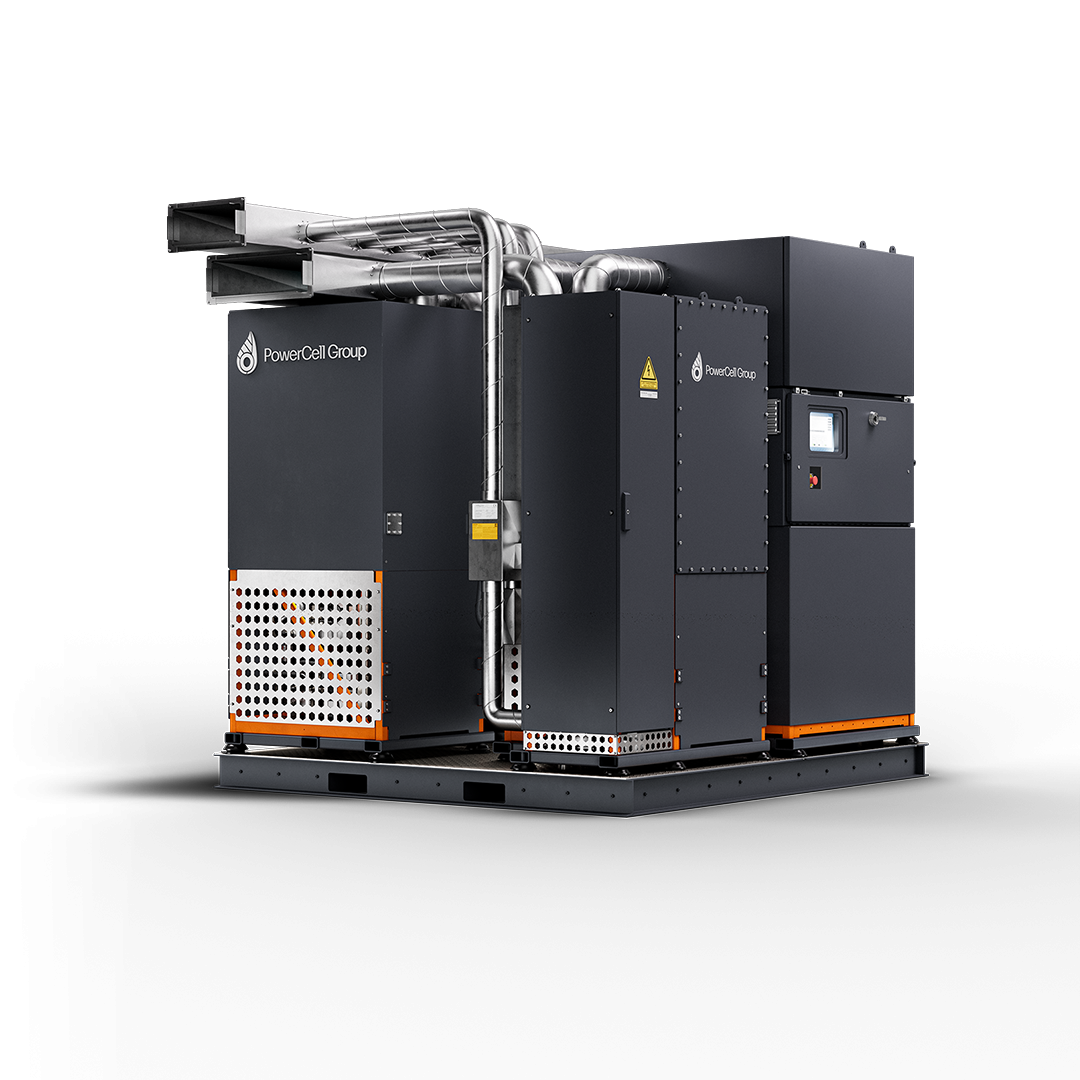
The M2Power 250 is a fully integrated methanol to power solution, combining methanol reforming with fuel cell technology for seamless integration into your vessel. It simplifies decarbonisation by generating clean hydrogen on demand, delivering 250 kW of reliable, sustainable power for marine applications.

Get in touch with us and steer towards cleaner oceans today.