Aviation
Aviation Engineering Services

Aviation
PowerCell Group is your partner in developing the next-generation zero-emission powertrain for any type of aviation. With our market-leading power density, we can support a wide range of applications, from drones to fixed-wing aircraft. Based on our extensive experience in assisting customers with their integrations, we have developed a methodology that guides you through all phases of the project — from analysing the mission profile to product development based on our hydrogen fuel cell technology.

We are dedicated to making the transition to hydrogen electric flights as seamless and efficient as possible.

With decades of experience in the fuel cell industry, we proactively identify and mitigate potential challenges to ensure a reliable and efficient implementation. Our solutions are already airborne, offering you proven technology that minimises technical risks and maximises operational success.

Our consultancy services deliver an optimised fuel cell solution tailored to your specific needs, significantly reducing your initial R&D investment. By leveraging our labs, testing capabilities, products and expertise, you can avoid the high costs and uncertainties of extensive research and development.

We accelerate your transition to zero-emission aviation, shortening the time to market. Our streamlined processes and proven methodologies ensure that you can start benefiting from cleaner, more sustainable power solutions without unnecessary delays.
We are dedicated to supporting your journey towards zero-emission aviation through the use of hydrogen fuel cells, guiding you every step of the way towards take-off. Our involvement will depend on your specific needs throughout the project until we achieve your customised solution.


We offer in-depth support during the feasibility stage, addressing preparatory questions and laying the foundation for your project.
Our engineers optimise the integration with existing aviation systems, using stakeholder input and preliminary testing to refine the concept.
Refining the prototype through rigorous testing and validation, ensuring it meets stringent performance and safety standards.
Finalising documentation and certification with aviation authorities, guaranteeing full compliance with regulatory requirements.
We establish production lines, conduct pilot runs, and implement quality control measures to ensure the reliability of the final product.
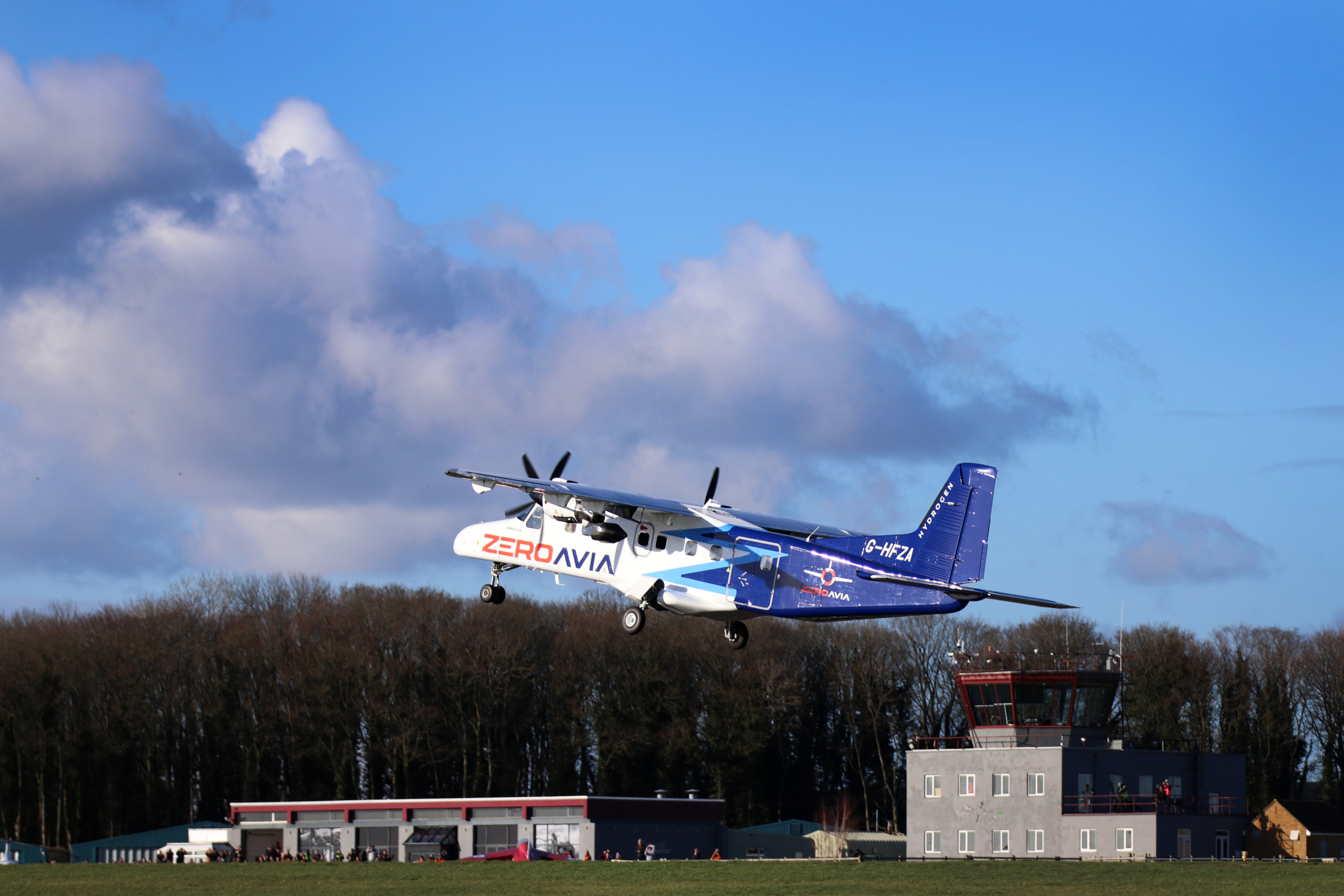

As the aviation industry faces growing scrutiny on its share of climate warming emissions and combustion alternatives come with clear downsides, true zero-emission flight with fuel cells is becoming a major focus. After completing 15 test flights with a one-engine plane, ZeroAvia is now conducting more advanced tests with a two-engine air- craft and redundant propulsion systems. When ZeroAvia’s 19-seater Dornier 228 twin-engine aircraft completed a 10-minute test flight in January 2023, it was the largest aircraft to have made a successful flight using a hydrogen-electric powertrain, with PowerCell fuel cell stacks as a core part of the system.

Our fuel cell expertise and ZeroAvia’s aviation experience are perfect for integrating a fuel cell system into an aircraft.

In comparison even to heavy-duty road transport, the importance of weight in aviation is exponentially higher. The fuel cell powertrain needs to have a high enough power/weight ratio to meet peak power requirements. ZeroAvia selected our technology because of its leading energy density and both organisations are partnering to optimise the weight of the system in the pathway to a final certifiable design.

We have designed a compact fuel cell system that is easy to integrate and provides a high power/weight ratio. The fuel cell uses hydrogen gas and oxygen from the air to produce electricity, emitting only heat and water vapor, which must be efficiently rejected from the plane. The solution is proven in harsh environments and has proven its durability and power output through extensive ground and flight tests.

In aviation, safety goes before optimisation, and two redundant propulsion systems in ZeroAvia’s testbed aircraft ensure double levels of safety. Batteries on board also provide redundancy and an extra power source at takeoff and rejected landings, where an instant increase in power is needed. With the help of a rigorous diagnostic system, We have validated the system redundancy and avoided several sources of single point failures.

The hydrogen-electric system is faster than a jet engine to ramp up the power when needed, which makes it not only the best way to decarbonise but a superior propulsion system overall.
We have developed specific software to meet ZeroAvia’s needs in terms of the application specification and risk management. For example, a control logic software to get maximum instant power outtake at rejected landings, when the plane needs to regain altitude fast.
The S3 is a ground‑breaking hydrogen fuel cell stack with flight‑proven performance. Built to strict quality standards for long‑term durability and reliability, it delivers zero‑emission electric power with industry‑leading power density in a compact form factor. Co‑developed with Bosch GmbH, the S3 is a fully industrialised solution backed by more than 100,000 hours of validation and testing, offering unmatched flexibility for aviation integration.


Contact us and start the journey towards sustainable aviation today.